
How to Choose the Right Air Duct Cleaning Company in Salinas
Most homeowners vet a duct cleaning company by its star rating and a logo on the van. That’s the wrong test. California doesn’t require a license to clean air ducts, so anyone with a shop vac and a Craigslist ad can call themselves a duct cleaning professional. What actually separates a real operation from a fly-by-night one is whether the owner can tell you, in plain English, what equipment is going into your home and how they’ll prove the job got done. If they’d rather not DIY the research, call (855) 360-8094.
Why “Licensed and Insured” Doesn’t Mean What You Think in Salinas
California has no mandatory licensing for air duct cleaning. That single fact reshapes how you should read every credential a company puts on its website. “Licensed” often refers to a general contractor’s license that may cover duct repair but says nothing about cleaning standards. “Certified” can mean a technician passed a real exam or simply that the company paid a trade association’s dues.
None of this makes credentials useless. It means the credential is a starting point, not the finish line. In our experience, the companies worth hiring are the ones that volunteer technical details without being pushed: what vacuum they run, how they set up containment, how long a full-system job takes. A company that gets defensive when you ask about equipment is telling you something.
Here in Salinas, the vetting problem has a local twist. Monterey Bay sits close enough that companies from other towns market into the valley without any physical presence here. A local address isn’t proof of competence, but it does mean the company has a reputation nearby to protect and a place to send a technician if something goes wrong. When you’re comparing duct cleaners in Salinas, ask where the business is actually registered and who shows up on the day. If the answer is vague, keep looking.
The Equipment Questions That Actually Matter
This is the heart of it. A duct cleaning vacuum is measured by the cubic feet per minute of air it moves, usually written as CFM. Consumer shop vacs pull a few hundred. Professional-grade systems pull several times that and are built to hold negative pressure so dislodged dust travels into the machine, not into your living room. A company should be able to name its equipment and explain why it chose it.
Ask these five questions before you book:
- What vacuum system do you use, and is it truck-mounted or portable? Truck-mounted units generally pull more air and dump exhaust outside the house. Portable systems can be excellent too, but the answer should be specific, not “we use the best.”
- What negative pressure do you set up, and how do you contain dust? Look for a real answer about sealing registers and running HEPA or equivalent filtration. Abatement Technologies filtration equipment, for example, comes from the same world as mold-remediation and hazardous-material work, and its use tells you the company thinks about airborne particles, not just the big chunks.
- How do you agitate the ducts? Cleaning without agitation often misses the settled film on duct walls. Rotobrush and Nikro systems use rotating brushes and air whips sized to flex versus rigid duct – the tools aren’t interchangeable, and a technician who understands that will explain why.
- Will you show me before-and-after footage from inside my ducts? A drain camera or duct camera is standard for a serious operation. If a company can’t show you its work, assume there’s nothing to show.
- Can you service my whole-home air quality equipment? If you have a Honeywell or Aprilaire system, familiarity matters. Companies that don’t understand this hardware can damage it.
None of these questions are trick questions. You’re just asking a professional to describe their process. The companies that answer cleanly know their tools; the ones that don’t have probably never been asked.
What a Legitimate Duct Cleaning Job Looks Like, Start to Finish
A real job follows a sequence, and a homeowner who knows the sequence can spot one that’s skipping steps. Here’s the general shape of a full-system cleaning:
- System inspection. The technician walks the house, counts registers, checks the air handler room, and looks for red flags: visible mold, rodent activity, disconnected flex runs, or damage that will change the approach.
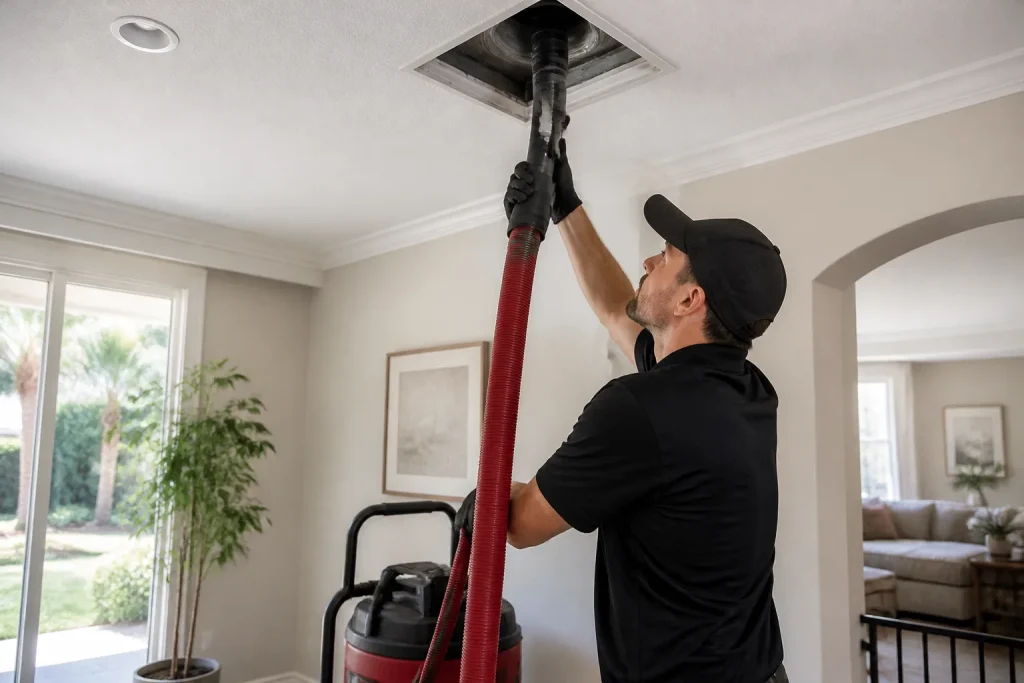
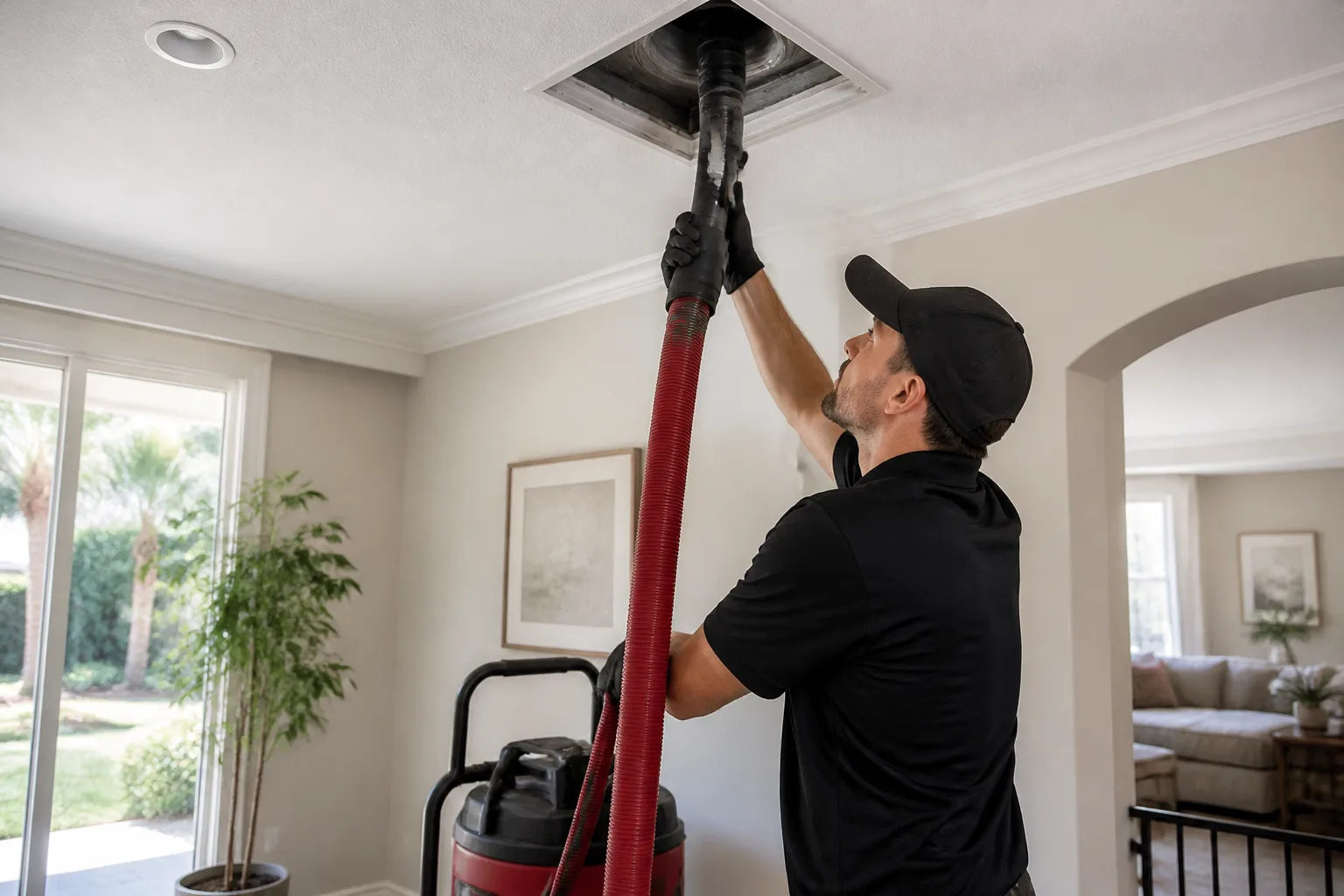
- Negative pressure setup. The vacuum is connected to the main trunk, registers are sealed, and filtration is running to keep dust airborne in the ducts and out of the rooms.
- Agitation pass. Rotating brushes and air whips travel each run, loosening the debris the vacuum will pull.
- Extraction. The vacuum removes everything the agitation freed. A professional-grade machine keeps the debris inside the equipment.
- Post-clean verification. The technician re-inspects with a camera, reseals registers, and walks you through what they found.
If a company can quote you a price before seeing your system at all, or skips the inspection because “they clean it the same way every time,” something is off. Systems vary too much for one-size pricing, and no honest duct cleaner can tell you what your ducts need without looking at them.
Red Flags That Show Up in Salinas
The Salinas market has a few recurring problems that are worth calling out directly, because the same tactics keep working on unsuspecting homeowners:
- The “no local address” operation. Companies from outside the valley that market into Salinas, run the job, and then disappear. Ask for a business address and confirm it. A local phone number is easy; a real presence is harder.
- Price deferral. A quote that requires a home visit to “assess” your system before any number is given can be a setup for a pressure sales pitch. A phone call should be enough for a ballpark, and the final price should be confirmed in writing before work starts.
- Upsells before inspection. If a salesperson is pushing an add-on or replacement system before a technician has looked inside your ducts, walk away. Find the problem first; quote the solution second.
- The “$99 whole house” teaser. Nobody can run a professional-grade vacuum, filter containment, agitate every run, and verify the results for that number. What happens is a “surprise” – usually mold, usually expensive, always conveniently diagnosed on site.
- No cameras, no photos. If the final report is verbal and there’s no footage, you have no way to know whether the work was done or how well.
The cleanest way to avoid these is to ask for equipment specifics on the phone before anyone gets in a vehicle. A real professional can answer confidently. A bad actor can’t fake that conversation for long.
What Certifications Actually Mean: NADCA, ACCA, and EPA
The main names that come up in air duct cleaning credentials are NADCA, ACCA, and the EPA. Each one means something specific, and each one is worth understanding so you can interpret a claim honestly:
NADCA is the National Air Duct Cleaners Association, a trade association. Membership is a reasonable baseline – the organization publishes cleaning standards and a code of ethics that members agree to follow. It is self-reported and paid for. It is not a government credential.
ACCA is the Air Conditioning Contractors of America, focused on HVAC design and installation standards. ACCA credentialing matters more for system design and sizing than for duct cleaning itself.
The EPA publishes guidance on indoor air quality and recommends that duct cleaning be done when there’s a reason – contamination, recent renovation, or a specific IAQ concern – rather than as routine maintenance. It’s worth reading the EPA’s homeowner guidance directly; it’s free and it sets expectations.
Treat all of these as useful context. The credential that closes the deal is the one a company can describe without flinching: the actual equipment, the negative pressure, and the verification process. Our technicians have up to 12 years of experience, and in our experience the tools say more about an operation than the wall art.
When to Call a Pro (and When Not To)
Duct cleaning isn’t a job that needs doing on a fixed schedule. The EPA says the standard itself is clear: if there’s no visible contamination, no mold, no pest problem, and no recent renovation, a system doesn’t strictly need cleaning. Call a professional when you notice one of these:
- Visible dust or debris discharging from registers when the system runs
- Musty or stale odors that don’t clear when the system is off
- A recent renovation, water intrusion, or pest problem in the ductwork
- Unexplained allergy symptoms that worsen indoors
- A dryer that takes longer than it used to, or feels hot to the touch – dryer lint is a fire risk, not a nuisance
- Visible damage, disconnected runs, or sagging flex duct
If your ducts are damaged, cleaning alone doesn’t fix the problem. Air duct repair may be needed first, which is why we handle both under one roof – you shouldn’t have to chase a second contractor to close the loop. Related services in Salinas: air duct cleaning for full-system service, and dryer vent cleaning for the fire-safety side of the same system.
Post-Service Verification Checklist
You’ve hired someone with the right equipment and the right answers. The work is done. Here’s what to check in the days after, so you know the job held:
- Registers. Grilles should be clean and flush, with no visible dust film at the edges. A small amount of trace dust on the first run is normal.
- Documentation. You should have a written summary of what was cleaned, what was found, and any repairs made. Camera footage or photos – before and after – should be included.
- System performance. Airflow should feel consistent across rooms, and odors should be gone, not replaced by a chemical smell.
- Recurrence watch. If odors or heavy dust return within a few weeks, that signals an incomplete job or a system issue the cleaning didn’t address. Call the company back and ask why. A serious operation should want to know.
If a company won’t return after a job, that’s the final answer on whether they were honest. Verifying in the days after protects you in a way no credential can.
The Bottom Line
In a trade with no mandatory licensing, the vetting work is yours. The companies worth hiring will name their vacuum system, explain their negative pressure setup, show you footage, and follow a real sequence: inspection, agitation, extraction, verification. They’ll answer equipment questions without hesitation because they know their tools. Nadca membership is fine as a baseline; the CFM rating, the camera footage, and the willingness to show their process are what actually separate professionals from pretenders.
If you’re in Salinas and need help, Duct Cleaning Salinas offers free estimates – call (855) 360-8094. We run Duct Cleaning Salinas with professional-grade equipment, not shop-vac shortcuts. Real local professionals, real answers to real questions. Our team is here to walk you through what your system needs and what the process looks like. Call (855) 360-8094. We answer 24/7. Fast dispatch from 7am to 7pm, Sunday through Friday.
Frequently Asked Questions
Ask about equipment first: which vacuum system they use, whether it’s truck-mounted or portable, how they set up negative pressure and containment, what agitation tools they use for flex versus rigid duct, and whether they’ll show you before-and-after camera footage of your own ducts. A company that can answer those cleanly is serious. One that deflects is not.
No. California has no mandatory licensing for air duct cleaning, so a “licensed and insured” claim often refers to a general contractor’s license that covers repair work, not cleaning itself. The practical substitute for a license is a specific, verifiable description of equipment and process. Call (855) 360-8094 for a free estimate.
It depends on the certifier. NADCA is a trade association with published standards and a code of ethics; membership is a reasonable baseline but self-reported and paid for. ACCA credentialing focuses on HVAC design and installation rather than cleaning. EPA guidance is worth reading directly, but the EPA does not certify duct cleaners. Treat any certification as context, not proof. Call (855) 360-8094 for an exact quote – estimates are free.
Camera footage from inside your ducts, before and after, plus a written summary of what was cleaned and any repairs made. If the company can’t or won’t provide that, assume the verification wasn’t done. Ask for it on the phone before booking; a real professional expects the question.
Only when there’s a reason: visible contamination, musty odors, mold, pest activity, a recent renovation, or worsening indoor allergy symptoms. Routine cleaning on a fixed schedule isn’t necessary for most homes. Call (855) 360-8094 for an exact quote – estimates are free.
Written by the team at Duct Cleaning Salinas.
Need Air Duct Cleaning Help?
Call Duct Cleaning Salinas - licensed & insured, here with fast help in Salinas.
(855) 360-8094